
D-Ring Anchors
fits 1986-2002 Toyota pickup/Hilux/4Runner/Hilux Surf and T-100
1995.5-2004 Tacoma models, Tundra, Highlander
Jeep Wrangler
Will replace standard in-line 2-bolt tow hooks on many import and domestic vehicles
 Designed and manufactured in
the USA by 4Crawler Offroad
Designed and manufactured in
the USA by 4Crawler Offroad
Contents:
[Return the the main 4Crawler Offroad page]

 |
 |
 |
| D-Ring Anchors | D-Rings/Anchors 3rd gen 4Runner | D-Ring Anchor - Tacoma Pickup |
Introduction:
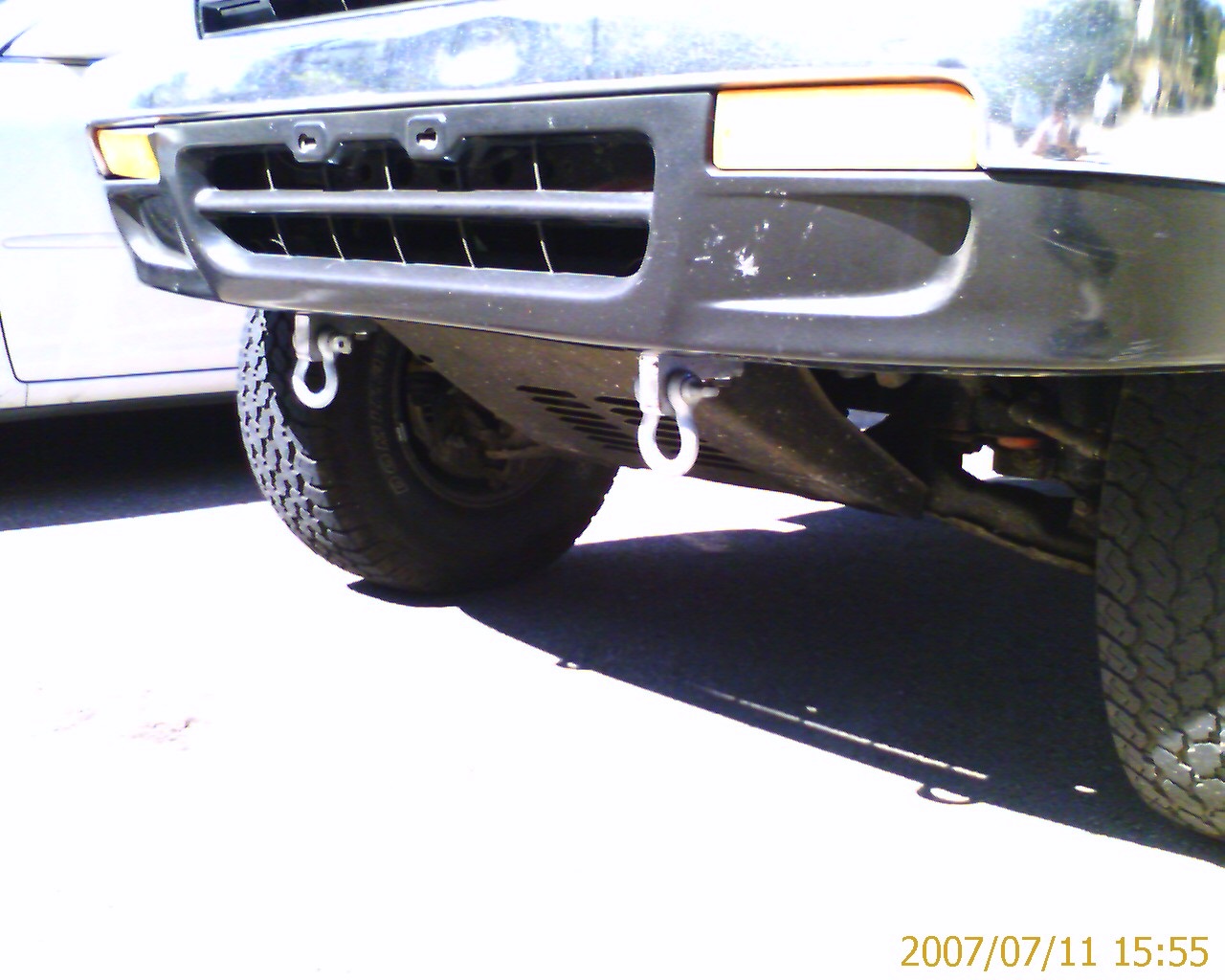
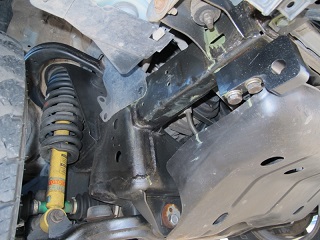
Most Toyota pickup, Hilux, 4Runner, Hilux Surf, Tacoma and similar models include either a tow hook or some sort of factory anchor point bolted to the underside of the front of the frame rail. These were typically used to secure the vehicle for shipping from the factory to the point of sale. However, for use in vehicle recovery in off-road use, these anchor points may be less than ideal. Tow hooks are usually nice and strong, but with the hook facing downwards, the tow strap or rope often slips out of the hook if you release the tension on it. The other style of factory anchor point is usually just a piece of steel with a hole in it. It is likely only rated for holding a vehicle down to the floor of a ship, but not for yanking the vehicle out of deep mud or off a pile of rocks.
But now there is a convenient bolt-on solution for a secure recovery point. We now have a D-ring anchor that will bolt up to the factory threaded holes under the frame rail. These D-ring anchors are machined out of billet steel and designed to exceed the strength of the 5/8" (16mm) D-ring anchor shackle they are designed to work with (pin diameter 3/4" - 20mm) as well as 3/4" (20mm) anchor shackles with 7/8" (22mm) hole diameter. We can also custom drill the anchors to fit 7/8" (22mm) shackles with 1" (24mm) diameter pins as well as a custom chamfered anchor for the popular 7/16" and 1/2" soft shackles. The added chamfer around the hole reduces wear and tear on the soft shackle material by eliminating the sharp edge,Photo Album - click on image to bring up description.
The anchors are machined of billet steel, a full 1" thick and weigh a massive 2.5 pounds (1.13kg) each. All the corners on the anchor are radius to minimize stress risers. It's hard to give a load rating on the anchors. They are designed to be at least as strong as the mounting bolts. That is, the anchor should stay intact if the pair of mounting bolts were to shear off. A conservative rating for that is approx. 95,800N or 21,400 lbs. The big unknown is what is the rating of the nuts welded inside the frame rail on the vehicle. Then on top of that you have the rating of the D-ring shackles, that are typically 3-1/4 ton in the 5/8" (16mm) size.
Fit:
These anchors are not made specifically for a given vehicle. Instead, they are designed to make use of standard 2-bolt tow hook mounting holes common on many truck and SUV frames. You can use the following dimensions to check if these anchors will fit on your vehicle. The anchors require a flat area of frame around the two mounting bolt holes about 2-7/8" (73mm) long with the two 12mm mount bolts spaced 1-3/8" (35mm) apart. The anchors are 1-3/4" (44mm) tall where the bolts attach them to the frame and 2-3/4" (70mm) tall overall in front where the D-ring attaches. The center of the D-ring pin hole is 2" (50mm) in front of the forward mounting bolt hole. You can measure the clearance around your factory tie down hook holes to see if these anchors will fit your vehicle. Toyota does use a hole spacing that is comparable to standard aftermarket tow hooks, so these D-ring anchor may fit other vehicles, although the bolt thread may be different, for example 1/2NC or 1/2NF thread on US vehicles. So be sure and check your frame for suitable flat area and height around the frame mounting bolt holes. If you need different size hardware, you can select the hardware size in the order forms. The default bolt length is 3-1/4" or 80mm which is enough to fit through the anchors and into the frame mounted nuts. You could also use these with drilled holes where you can fit a nut on the back side. Likewise, if you want to use a larger d-ring shackle, we can drill out the hole to a larger diameter, up to 1". Drop us a note for a custom quote.
Factory solid axle Toyota trucks (1985 and older) may have clearance issues with the front spring hanger bolts and trucks with solid axle swaps might have clearance issues with spring hanger gussets, so be sure and check for adequate clearance. Minor cutting and/or grinding of the D-ring anchors may be required in those situations.
If you want to check fitment against your vehicle, see the above dimensions for the anchor block and compare those to the existing holes in the underside of your frame. These anchors also have the same hole spacing as common tow hooks, so if you want to replace a tow hook with a D-ring anchor, this is the part for you.
- YouTube videos:
-
https://youtu.be/jAUz2FaWR4w
- https://youtu.be/4Bwjwq62KUE
- Google Photo Album with more images, click on photo to see detailed description.
- https://youtu.be/4Bwjwq62KUE
Anchor Shackle Dimensions:
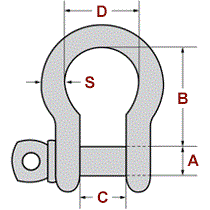
Note that anchor shackles are specified by the nominal diameter of the "bow" or D-ring part, the screw pin will normally be a larger diameter.
 |
. | . | . | . |
| Screw Pin Anchor Shackle Dimensions | A | B | C | D |
| S = 1/2" | 0.625" | 1.88" | 0.81" | 1.31" |
| S = 5/8" | 0.750" | 2.38" | 1.06" | 1.69" |
| S = 3/4" | 0.875" | 2.81 | 1.25" | 2.00" |
| S = 7/8" | 1.000" | 3.31 | 1.44: | 2.28" |
These are inch dimensions shackles. For metric shackles, the pin diameter should be 19mm and the throat width 26mm.
You'll notice column C is the "throat" of the shackle, that needs to be at least 1" to fit over the anchor block. Column A shows the diameter of the pin and thus the diameter of the hole in the anchor.
We also can supply screw pin anchor shackles to go with the anchor blocks for a complete recovery setup. Note that anchor shackles are a forged steel part and have a hot dipped galvanized finish. Both these processes can lead to a rough finish that may impeded fitting over the precision machined anchor blocks. We check and correct the fit of the shackles to the anchors including filing off any flashing/roughness inside the "C" opening to fit over the anchor blocks. We also clean up any roughness on the pin and threads to allow it to fit through the hole in the anchor block.
The D-ring shackles, 5/8" (16mm) nominal diameter, have a screwed in pin which lets you insert the pin through the anchor and screw it securely into the shackle to lock the shackle to the anchor. With the loop of a tow strap inserted in the body of the shackle, this gives you a secure attachment point for the front of the vehicle that can't come apart. Yet, it is easy to unscrew the shackle pin to remove the shackle and strap after use without having to worry about a knot getting too tight.
The anchors are conservatively rated at 10,000 lb. / 5 tons / 4545kg. working load limit. The limiting factor will be the mounting bolt holes in the frame.
For larger D-rings, it's a simple matter to drill out the existing anchor hole to accommodate the larger anchor pin. If you lack the tools to do this operation, we'll be happy to drill out the hole to 7/8" or 1" dia. for a cost of $7.50/hole. Note that the diameter of the shackle pin is typically 1/8 (3mm) larger than the nominal size. Contact us for details. Custom drilled anchors can be ordered below.
The 5/8" - 7/8" D-ring shackles will all work with the shackle anchors, along with the popular soft-shackles. If you already have one or more shackles, pick the anchor that works with the size/type shackles you already have. If you are planning to get shackles with the anchors and don't know which size to get, here's some tips:
-
The 5/8" shackle is the smallest, lightest, least expensive and
closely fits over the anchor.
- If you need a higher rating than the normal 3.25T steel shackle, you can get higher ratings in an alloy version.
-
The 3/4" (20mm) shackle size is very popular and fits the anchor well.
The throat width is about 1/4" wider than the anchor.
- Soft shackles are typically designed to replace D-ring shackles and we can modify the anchors to work with the soft shackles by chamfering the edges of the hole. Soft shackles use spliced UHMW rope and are sized by the rope diameter. Since the splicing increases the diameter of the shackle, we offer 2 hole sizes. The smaller size fits the 7/16" rope, or 1/2" rope w/o a protective sheath. The larger size hole fits the 1/2" rope with a protective sheath.
- A 7/8" shackle is pretty large and has a high working load limit. We can drill out the anchors to fit this size shackle if that's what you need.
[Return to the top of this page]
Ordering Information:
NOTES:
- This has been a very popular product, but at this time we're not able to continue offering it for sale and we've sold out of our inventory.
-
We've made the 3D CAD files
available for personal use, for a nominal fee, if you want to have a go at making your own anchors.
-
There's an ever expanding selection of on-line 3D Printing and Machine Shop services available today if
you can't locate a local machine shop. A few that we've heard of:
- Xometry.com, ProtoLabs.com, Mfg.com, eMachineShop.com, Hubs.com, RapidDirect.com, RenovoCNC.com, PartsBadger.com, ProtoTek.com, FicTiv.com, Jlc3DP.com, PCBWay.com, etc.
-
There's an ever expanding selection of on-line 3D Printing and Machine Shop services available today if
you can't locate a local machine shop. A few that we've heard of:
-
If any individual, group or company would be interested in acquiring the rights to this D-ring
Anchor design, please contact us
- We can set you up with a high quality US machine shop that's set up to make these parts in quantity
The new and improved D-Ring shackle anchors are sized to fit both 5/8" and 3/4" (16mm and 20mm) forged shackles out of the box and also a new soft shackle version.
Known to fit
-
1986-1995 Toyota Pickup/Hilux
- T-100 pickup
- 1986-2002 model year 4Runner/Hilux Surf.
-
1995.5-2004 model year Tacoma pickups
- Also fits Tundra and Highlander models
- Jeep Wrangler
- For other models/years, please check the fitment information before ordering
Mounting bolts:
- For the Toyota vehicles, 12mm extra fine thread (M12-1.25) is common
- - Also M12-1.5 fine and M12-1.75 coarse thread pitch is available
- - Upgrade to 12.9 hardware if desired
- Jeep Wrangler models, 1/2" coarse thread (1/2-13/NC) is common
- - Also 1/2" fine thread (1/2-20/NF) is available, upgrade to grade 9 hardware if desired
- If in doubt about the thread diameter and pitch on your vehicle, pull out one of the bolts and measure it.
These D-Ring anchors are proudly designed and manufactured in the USA.
- US$65.00/anchor (#DRingAnchor) or US$125.00/pair (#DRingAnchorPr) plus shipping - Sold Out
-
Add US$5.00/hole for custom drilled anchors - allow ~1 week for
custom machining - Sold Out
- Size option is shown as "nominal pin dia." and "hole dia."
-
Anchors need 2 longer than stock mounting bolts
- M12-1.25, M12-1.50, M12-1.75 grade 10.9
- - Factory tow hook / tie down bolts are grade 8.8
- - Grade 12.9 bolts are available in select sizes, these are Allen head bolts w/ 10mm socket head
- or 1/2-NC, 1/2NF Grade 8 or optionally Grade 9 with hex head
- Other mounting bolt sizes possible, contact us for details.
-
Finish:
- Anchors - bare steel, primed or cold galvanized (+US$2.50/anchor for primter) so you can paint to match your vehicle
- - Bare steel is good if you want to use powder coating or another finish
- - Etching primer gives the best surface finish for painting if that's important to you, it has a 1%-2% zinc content
- - Cold galvanize primer gives better rust protection with 25%-50% zinc content, in contact with the steel, it does leave a rougher surface finish
- - Allow a few days for primer application and drying time
- Shackles - hot dip galvanize
We have a limited stock of items such as:
- Steering Extensions
- Driveshaft Spacers
- Upper Control Arm braces for 2WD Toyota pickups
- Weld-on Cab / Body Mount brackets
- Seat Lift kits
- Starter Solenoid Contacts
- Bilstein Shocks for VW pickups
- H4 switched power headlight relay harness
-
Some customers have reported issues with the Paypal order buttons while using the Safari web browser on an iPhone.
- If so, try a different browser and see if that works better.
| 4Crawler Offroad contact link | MissingLinkZ contact link |
Check out our growing collection of on-line design information so that you can make your own parts. Maybe you have a neighbor or acquanitance that can help or check out a local maker space or adult education machining class. Or engage a local or on-line machine shop to make them for you. Before you ask, no, we're not making any more of these items, rather we wanted to empower YOU to be able to make your OWN custom parts.
You'll find designs for body lift, suspension components and more, below:
- Thingiverse
- Printables
- Cults3D
- Maker World/BambuLab
-
GitHub
-
Includes RockSliderz and IFS Frame Brace designs
There's a wide selection of on-line 3D Printing and Machine Shop services available today. A few that we've heard of:
- Xometry.com, ProtoLabs.com, Mfg.com, eMachineShop.com, Hubs.com, RapidDirect.com, RenovoCNC.com, PartsBadger.com, ProtoTek.com, FicTiv.com, Jlc3DP.com, PCBWay.com, SendCutSend.com, etc.
-
Many of our model files use OpenSCAD and if you need to convert those to other CAD formats, use FreeCAD.
- Simply import the OpenSCAD file into FreeCAD then export it in the desired CAD format the on-line shop requires.
Shipping:
- USPS shipping rates
- Single anchor or d-ring ships in USPS small flat rate box
- Pair of anchors or d-rings ships in USPS small flat rate box (US only)
-
Pair of anchors and d-rings ships in USPS medium flat rate box
- Due to USPS international flat rate postage weight limits, we can only ship one anchor or shackle per small flat rate box
- Orders for 1 pair of anchors and/or shackles can ship in a ships in USPS medium flat rate box
-
We can also ship in 2 (or more) small flat rate boxes, possibly at a
lower cost:
- For this option, order the single anchor with quantity = 2 instead of one pair
- Yes, with USPS flat rate international postage, it may be less expensive to ship small 2 boxes instead of 1 larger box.
- Or contact us with your shipping information and we can provide shipping options.
- Shipping cost will be displayed on the 2nd screen of the checkout process
- Returns and exchanges
- Cancellation Policy
Which anchor to order:
- For a 5/8" (16mm) D-ring shackle: Select the STANDARD anchor will work
- For a 3/4" (20mm) D-ring shackle: Select the STANDARD anchor will work
- For a Soft Shackle: Select CUSTOM anchor according to the soft shackle size, 7/16 in. or 1/2 in.
- For a 7/8" D-ring shackle: Select CUSTOM anchor 7/8 in. forged shackle will work
- In other words, the STANDARD anchor will fit the 5/8" and 3/4" forged shackles. For the larger 7/8" forged shackle and the 2 soft shackle sizes, we need to modify the hole in the anchor, i.e. CUSTOM anchor.
Sold Out - Select the bolt size/thread to match the mounting holes in your frame
- Ordering buttons have been disabled
- Upgrade to metric 12.9 or SAE Grade 9 hardware
- D-ring shackles to fit these anchors
| Single standard Anchor - SOLD OUT | Pair of standard Anchors - SOLD OUT |
| ===================================== | ===================================== |
| Single custom Anchor - SOLD OUT | Pair of custom Anchors - SOLD OUT |
| ===================================== | ===================================== |
| Single standard Anchor - Canada shipping | Pair of standard Anchors - Canada shipping |
| Single custom Anchor - SOLD OUT | Pair of custom Anchors - SOLD OUT |
| ===================================== | ===================================== |
| Single standard Anchor - SOLD OUT | Pair of standard Anchors - SOLD OUT |
| ===================================== | ===================================== |
| Single custom Anchor - SOLD OUT | Pair of custom Anchors - SOLD OUT |
Upgraded hardware:
Sold Out - For customers desiring upgraded mounting hardware, we now offer an upgrade to metric grade 12.9 and SAE grade 9 hardware.
- The upgraded hardware is an additional US$6.00/pr of bolts (item: HDbolts), sufficient for one D-ring anchor.
- If ordering a pair of anchors, be sure to set the quantity to 2
- This option only applies to an open D-ring anchor order and means placing a 2nd order
- - If you want to get a set of upgraded hardware separately, contact us for details
| Upgrade to Grade 9 or 12.9 hardware - SOLD OUT |
D-Ring Shackles:
-
5/8" D-Ring anchor shackles, galvanized steel (3.25ton/6500
lbs/2950 kg. rated) US$19.00/ea. - In stock
- More compact size and tightly fits the shackle anchor
We have a limited stock of items such as:
- Steering Extensions
- Driveshaft Spacers
- Upper Control Arm braces for 2WD Toyota pickups
- Weld-on Cab / Body Mount brackets
- Seat Lift kits
- Starter Solenoid Contacts
- Bilstein Shocks for VW pickups
- H4 switched power headlight relay harness
-
Some customers have reported issues with the Paypal order buttons while using the Safari web browser on an iPhone.
- If so, try a different browser and see if that works better.
| 4Crawler Offroad contact link | MissingLinkZ contact link |
Check out our growing collection of on-line design information so that you can make your own parts. Maybe you have a neighbor or acquanitance that can help or check out a local maker space or adult education machining class. Or engage a local or on-line machine shop to make them for you. Before you ask, no, we're not making any more of these items, rather we wanted to empower YOU to be able to make your OWN custom parts.
You'll find designs for body lift, suspension components and more, below:
- Thingiverse
- Printables
- Cults3D
- Maker World/BambuLab
-
GitHub
-
Includes RockSliderz and IFS Frame Brace designs
There's a wide selection of on-line 3D Printing and Machine Shop services available today. A few that we've heard of:
- Xometry.com, ProtoLabs.com, Mfg.com, eMachineShop.com, Hubs.com, RapidDirect.com, RenovoCNC.com, PartsBadger.com, ProtoTek.com, FicTiv.com, Jlc3DP.com, PCBWay.com, SendCutSend.com, etc.
-
Many of our model files use OpenSCAD and if you need to convert those to other CAD formats, use FreeCAD.
- Simply import the OpenSCAD file into FreeCAD then export it in the desired CAD format the on-line shop requires.
| 3.25 ton D-Ring Shackle - SOLD OUT |
| ===================================== |
| 3.25 ton D-Ring Shackle - SOLD OUT |
[Return to the top of this page]
Installation Process:
The D-ring anchors come ready to paint, galvanize or powder coat, as you prefer. You can use a metal primer and paint to match your vehicle color if desired. You can have a local shop galvanize or powder coat the anchors. Or you can use a cold galvanize spray paint. Or just use some inexpensive spray paint and touch up the anchors as needed. Since the finish will get scraped and dinged up with use, having a finish that can be easily touched up is a good idea.
There are 2 schools of thought on a painted finish.
- 1: Use a high end paint system like a POR-15 metal primer and top coat. It's expensive but will last a long time.
- 2: Get an inexpensive spray paint and then touch it up as needed.
Installation could not be easier. If there is an existing tow hook or tie down anchor already attached under the frame in front, remove it. Those existing bolts may be in there tight, so take your time and carefully break them free. Those bolts go into nuts welded up inside the frame, so take care you don't damage those nuts while removing the bolts.
If you do not have anything installed in the frame and the holes have been open for some time, you might want to clean them out first. To do that, if you have an old bolt that fits the hole/threads, use that, otherwise use one of the supplied bolts. First, lube up the threads inside the frame and on the bolt. Then carefully thread it into the hole and screw it in a turn or two then back it out before it gets too tight. Clean off the bolt threads with a wire brush and re-lube and repeat going in a bit farther and removing, until you can run the bolt in a good inch or so without it binding up.
Now you are ready to install the anchors, be sure the frame metal is clean under where the D-ring anchor will sit. Check the fit of the anchor against the frame and if it does not sit flat and solid, clean up any bumps or surface imperfections under the frame with a file or grinder. Might also be a good idea to touch up the paint there if you had to do any grinding.
Now time to thread in the bolts. Some sort of anti-seize compound or grease for the threads is a good idea in case you ever want to remove those bolts. Be sure to get both bolts started by hand to make sure you have not cross threaded them. Then tighten down the bolts alternately until the anchor is seated against the frame. Now torque down the bolts to approx. 100 N-m (75 ft.lb) if using thread lube, otherwise 115 N-m (86 ft.lb) for dry threads. Toyota lists torque values in the 65-85 ft.lb. range for the factory tie downs. With the torque, more is not better, so if you have to err on one side or the other, a bit less is better than a bit too much. Basically tighten up the bolts about what you use on your wheel lug nuts.
If using your own d-rings, test the fit around the anchor. You may need to file or grind a little bit to clean up the inside face of the d-ring to clear the anchor. The Shackles and/or pins often will have some excess metal from the forging or galvanization process and/or the rolled threads may make that part a bit larger in diameter. This is easy to file or grind off, just take the sharp edges off and test the fit in the d-ring anchor hole and repeat until it fits. We designed the anchors to have a hole just large enough for the 5/8" pin for maximum strength. As most d-ring anchor shackles are made overseas nowadays, the quality control is often lacking and the threaded ends end up way oversize. We do this fitting work for you with the d-rings we supply. Then as far as where to keep the shackle, in the anchor or in your truck? Both work, but we prefer to keep the shackles safe inside the truck with our other recovery gear. Outside, the anchor might unscrew and fall off or someone may walk off with it. Plus, despite the snug fit of the shackle and anchor, there will be a little rattling there, especially on bumpy roads.
We recommend that the shackles not be left in the anchors full time because they're thief magnets. But if you do want to leave them in place, you can also apply a layer tool handle coating, bed liner or heat shrink tubing over the shackle pin if you want it to be quieter when inserted into the anchor. This will eventually wear away and need replacement.
- Tool handle coating
- Bed liner spray
- Heat Shrink Tubing. Select a size somewhat larger that the diamter of your shackle pin, around 1".

[Last updated: 31.October.2025 ]
Visitor # since 11.DEC.2011